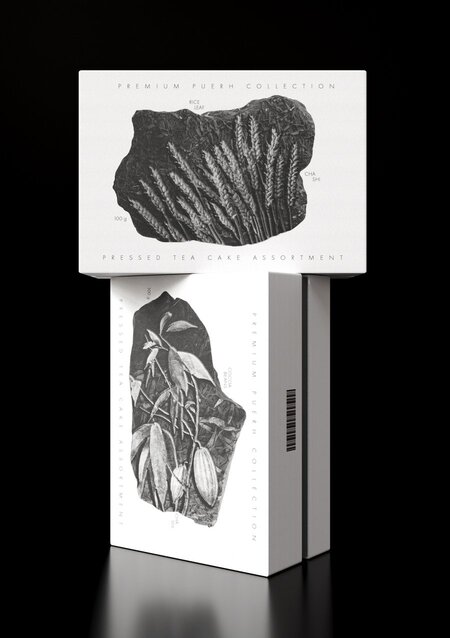
Cha shi: Communication Strategy
How the communication theory works in packaging design
Communication theory in design conceptualizes visual communication as a symbolic, relational, and culturally embedded process in which meaning arises through coordinated actions between designer, artifact, and audience.
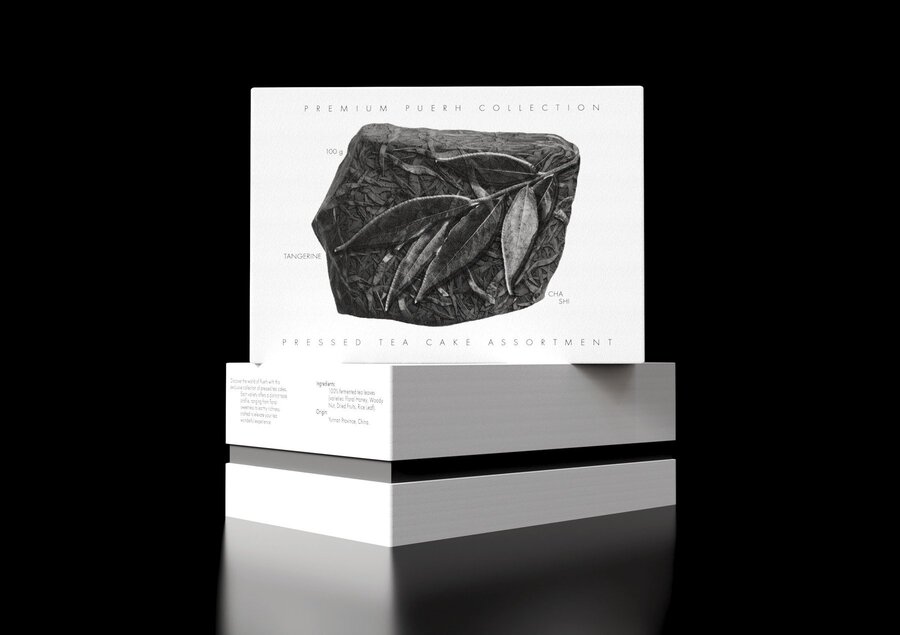
Cha Shi. Dmitrieva Polina. 2025 [1]
Design is not merely a technical task, it is shaped by context, culture, identity, and social norms. Communication is not simply what is sent but what is jointly constructed through signs, expectations, and interactions. This perspective aligns with theories that view communication as ritual, as the management of meaning, and as a dynamic process that evolves through feedback and social negotiation. Within this framework, design becomes a communicative environment where symbols, materials, and forms help people construct understanding rather than simply deliver a message.
We chose the Central Elaboration Likelihood Model (ELM) (O’Keefe, 2012). It could be useful, when people are interested in carefully considering the information, able to process it, and personally engaged with the issue. The Central Route mainly involves careful thinking and effort to understand a message. It requires deep thought and the evaluation of arguments based on their quality. For example, when you’re researching all the details before buying a laptop, you’re using the Central Route. This kind of thoughtful process can lead to lasting changes in attitude and make you more likely to resist opposing arguments later.
Presentation for a general audience
Cha shi, a brand built around Chinese pu’er pressed into stone-like forms, applies this understanding of communication as a symbolic and culturally situated process. The use of 茶⽯ — «tea stones» serves not only as an aesthetic reference but as a culturally resonant symbol that functions across multiple communicative layers.
Cha Shi. Dmitrieva Polina. 2025 [2]
Cha Shi. Dmitrieva Polina. 2025 [3]
Through a semiotic lens, each tea stone becomes a sign that points toward origin, earth, longevity, and memory. Through a socio-cultural lens, the stones participate in a larger ritual practice that involves slowness, observation, and respect for natural processes. Through an interpretive lens, meaning is not embedded in the object itself but arises through the audience’s interaction with the material form and associated cultural narratives. This aligns with theoretical perspectives that position receivers as active meaning-makers negotiating signs within their own contexts and cultural identities. The brand also employs positive politeness, which builds connection and solidarity. Like saying, «You’re so organized — could you share your notes?» to encourage companionship, Cha shi invites its audience to engage with shared cultural values, creating a sense of mutual respect and active participation.
Cha Shi. Dmitrieva Polina. 2025 [4]
In communication aimed at general audiences, the brand uses an expressive mode oriented toward sensory experience and emotional resonance. The ritual of holding a stone, watching it soften in water, and perceiving its gradual transformation invites audiences to participate in a symbolic act rather than passively consume a product. The brand’s communication deliberately avoids excessive instruction, reinforcing theories that emphasize the value of open, low-imposition messaging that protects receivers’ autonomy and positive face needs.
Cha Shi. Dmitrieva Polina. 2025 [5]
The indirect and suggestive imagery associated with Cha shi mirrors communication models that highlight subtlety, context, and relational sensitivity as essential for fostering engagement. This value aligns with the concept of 'excellent communication, ' which is carefully orchestrated to fulfill organizational objectives while harmonizing the needs of both the organization and its key audiences through a reciprocal, two-way symmetrical communication model. In terms of «excellent» public relations, the Senior PR Director must play a key role in strategic management, integrating PR efforts into the broader organizational plan. Communication should be continuous and controlled, with the PR director being part of the leadership team to ensure alignment with organizational goals. Additionally, diversification is crucial, ensuring equal opportunities for all genders and ethnic groups within the PR strategy (Grunig J. E., 2011).
Presentation for a professional audience
In communication designed for professional audiences, the messaging adopts a rhetorical and analytical structure, reflecting communication theories that emphasize intentional persuasion, argument coherence, and disciplinary norms.
Cha Shi. Dmitrieva Polina. 2025 [6]
Cha Shi. Dmitrieva Polina. 2025 [7]
Here, the design system is articulated as an interconnected network of signs and decisions: textures referencing geological strata, typographic structures inspired by carved surfaces, and a color palette derived from mineral hues. This level of transparency speaks to the professional community’s expectation of clarity, methodological grounding, and conceptual thinking. Such adaptation illustrates the importance of audience-centered design and aligns with communication theories that frame interaction as contingent on shared knowledge, expectations, and communicative competence. The Theory of Planned Behavior further complements this approach by acknowledging how communication influences real actions. According to the theory, behavior is determined by three factors: a subjective norm (what others will think), a personal attitude (individual beliefs and preferences), and controlled beliefs (the feeling of being able to perform an action) (I., 1991). These factors interact to shape and predict behavior, highlighting the importance of understanding both the professional audience’s expectations and their perceived ability to act based on the message being communicated.
Cha Shi. Dmitrieva Polina. 2025 [8]
Communication theory as basis for the presentations
The brand’s overall communication strategy incorporates several theoretical dimensions. The socio-cultural perspective frames Cha shi as a continuation and reinterpretation of cultural practice, rather than a static product. The semiotic perspective explains how the material form of tea becomes a communicative code that audiences decode through sensory, cultural, and emotional channels. The cybernetic perspective highlights the importance of feedback loops, where consumer interpretations refine the evolving visual and verbal language of the brand. The critical perspective encourages distancing from stereotypical or exoticized representations of tea culture, instead fostering a nuanced and respectful engagement with tradition.
Cha Shi. Dmitrieva Polina. 2025 [9]
Cha Shi. Dmitrieva Polina. 2025 [10]
The brand also applies the Functional Communication Theory through its Four Required Functions (Grunig J. E., 2011). Problem analysis is used to deeply understand the issues surrounding audience engagement and cultural representation. Goal setting defines clear criteria for evaluating communication effectiveness and alignment with brand values. Generating alternatives allows the brand to explore a wide range of creative and strategic options for messaging, while evaluating alternatives ensures that each option is carefully weighed for potential benefits, risks, and overall suitability. This systematic approach helps the brand maintain both cultural sensitivity and strategic simplicity in its communication.
Cha Shi. Dmitrieva Polina. 2025 [11]
Further, the brand leverages insights from theories focused on human behavior, identity formation, and persuasive processes. Ritual-based communication theories support the idea that repeated, embodied interactions—such as the brewing of tea stones—reinforce identity and emotional attachment. Models of meaning coordination explain how shared narratives about place, nature, and craft allow audiences to integrate cha shi into their cultural and personal stories. Persuasion theories suggest that sensory immersion and narrative coherence stimulate deeper engagement through the central route of processing. Norm-driven models describe how cultural expectations surrounding tea preparation shape intention and behavior, supporting repeat engagement and long-term loyalty.
Cha Shi. Dmitrieva Polina. 2025 [12]
Through this integration of theoretical principles, Cha shi exemplifies how design becomes a communicative system rather than a decorative layer. Each tea stone operates as a symbolic event, each act of brewing serves as a ritualized expression of meaning, and each visual element contributes to an environment where sender and receiver continuously negotiate significance. This approach positions communication not as a unidirectional act, but as a dynamic, situated, and collaborative process that shapes how the brand is experienced and understood.
Sources
Characteristics of excellent [Раздел книги] / авт. Grunig J. E. Grunig L. A. // The IABC handbook of organizational communication: A guide to internal communication, public relations, marketing, and leadership. / авт. книги Grunig J. E. Grunig L. A. — San Francisco : Jossey Bass, 2011.
The SAGE Handbook of Persuasion: Developments in Theory and Practice [Книга] / авт. O’Keefe Daniel J. — Thousand Oaks : SAGE Publications, Inc., 2012.
The theory of planned behavior [Раздел книги] / авт. I. Ajzen // Organizational behavior and human decision processes / авт. книги I. Ajzen. — [б.м.] : John Wiley & Sons, Inc., 1991.
https://files.mediiia.ru/postimages/21574/2dbdffc7a149438ea05033cb31f193f7/012fe914f1934f24a4f6369010efffbc1800x1270.jpg (Date of request 14.12.2025)
https://files.mediiia.ru/postimages/21574/9e79f61a48524abbb48d69f4c24b0ff4/3a2734c835f740c9a85e6619c76c03521800x1270.jpg (Date of request 14.12.2025)
https://files.mediiia.ru/postimages/21574/a9b9354912844172bd8b35f590e131f0/04ef9ca53773493d8172bed960a5eefc1800x1270.jpg (Date of request 14.12.2025)
https://files.mediiia.ru/postimages/21574/f3618c869bc040ec88d53deb5d0364fe/808ecf2df7ec40a3a793c8910de74540_orig.gif (Date of request 14.12.2025)
https://files.mediiia.ru/postimages/21574/d14816a1e36d46aeae9eb1d31e293fcc/3ab53e8cee7e41d5841ad7a18847514f1800x1270.jpg (Date of request 14.12.2025)
https://files.mediiia.ru/postimages/21575/5cd77528e89f46aab29f9698e1526a0c/871133897f2149fd95ff30ca0eae9690_orig.gif (Date of request 14.12.2025)
https://files.mediiia.ru/postimages/21575/ac094a5616fd4136b426225be0c814d1/ce26ecc2dacf4a65a3710df8a4c0b8a11800x1270.jpg (Date of request 14.12.2025)
https://files.mediiia.ru/postimages/21579/630906bb7f364c119cdb1e2cb9743ded/6d5a441a32c249dcbb5a8f9358a72c5c_orig.gif (Date of request 14.12.2025)
https://files.mediiia.ru/postimages/21580/37eb5fd2e6e1417582128e89d825ea3e/3bafb5679c37461689dad342daf2020a1800x1270.jpg (Date of request 14.12.2025)
https://files.mediiia.ru/postimages/21578/7d819cde12e54f8fb3c2a450c3737ecb/d57e0bb89d12460383f2be4b3a41acb01800x1270.jpg (Date of request 14.12.2025)
https://files.mediiia.ru/postimages/21577/2b40640ba18b41a18d20a5d4e5ea9145/b62a049804574e99a8357b4eac89837c1800x1270.jpg (Date of request 14.12.2025)