Communication theory: LISTA
Contents:
I. How Communication Theory Works in Design II. LISTA for a General Audience III. LISTA for a Professional Audience IV. How Communication Theory Shapes Professional Strategy V. Bibliography and Image Sourses

I. How Communication Theory Works in Design
In our everyday life we see design as visual — posters, packaging, logos. But in this project, we treat design primarily as communication. A label, a video, or a social media post sends a message and shapes how people understand a brand. Communication theory explains why some visuals work and others fail. It reveals how media influence perception, how people interpret images, and how design persuades or engages an audience.
Media Ecology — The Medium is the Message
Marshall McLuhan argued that the medium itself communicates the message, independent of content. A billboard, a phone screen, and a physical object convey the same idea differently. In herbal tea brand LISTA, we chose a reusable metal container as our primary medium. Before the consumer reads any text, the material communicates: permanence, premium quality, tactility, sustainability. The embossed line design engages touch — a sense that paper packaging cannot activate. The container is also a «cool» medium in McLuhan’s sense: it requires active engagement. The consumer holds it, feels the embossed line, scans the QR code, and watches video. This progression of sensory experience is more memorable than text alone.
Framing Theory — Color and Form Direct Interpretation
Framing theory states that the way information is presented shapes interpretation, independent of facts. In design, frames operate through color, composition, and visual structure. Each region in LISTA uses a distinct frame. These frames work before conscious reading. They prime emotional response.
Narrative Paradigm — People Believe Stories
The narrative paradigm shows that people process information through stories, asking: «Does this feel true to me?» and «Does this match my values?» The drone video accessed via QR code tells a narrative: establishment of landscape → development through terrain → arrival at the tea source. This structure is coherent (logically constructed) and faithful (real footage of real places). Crucially, the embossed line on the container mirrors the video narrative. Altai’s ascending line echoes upward camera movement. This visual-tactile repetition anchors the story across multiple experiences.
Symbolic Convergence — Shared Symbols Build Community
Ernest Bormann argued that shared symbols create group consciousness. The map of Russia on visuals functions as a symbolic anchor, not a functional one. When a consumer sees this map, they unconsciously think: «This is part of a larger journey. I’m part of a group exploring Russian regions.» This symbol enables fantasy chaining: when one person’s story about the brand triggers others to create related stories, forming shared group identity.
Uses and Gratifications — Understanding Active Audiences
The reusable metal container satisfies multiple simultaneous needs: • Information (authentic origin) • Aesthetic (beautiful object to own) • Identity (signals eco-consciousness and cultural sophistication) • Social (shareable on platforms, gifts for travelers) • Ritual (transforms daily brewing into ceremony) Unlike disposable packaging (gratification ends immediately), the reusable container provides repeated gratification across all dimensions with every use.
Digital Rhetoric — Visual Persuasion
On social platforms, designers function as modern rhetoricians. We build visual arguments through brief, memorable imagery designed for sharing. LISTA’s strong color contrasts and embossed line designs work as asset — instantly recognizable and emotionally resonant.
These five theories form the foundation of LISTA’s design system. Rather than treating them as abstract concepts, we embed them directly into the physical medium, the visual language, and the communication strategy. The result is a complete communication experience where every element: material, color, form, symbol, and digital extension — works in concert to transmit meaning and build community.
II. LISTA for a General Audience
LISTA is a herbal tea brand that celebrates three Russian regions and everyday exploration. Each container represents one region landscape through a short drone film accessed via QR code. Our mission is simple: turn a regular cup of tea into a small journey. When you brew LISTA, you don’t just drink tea — you travel through Altai mountains, wind through Caucasus valleys, or navigate Karelia forests. LISTA stands for the joy of discovery, authentic connection to place, honest simplicity, and love for regional Russian culture. The brand addresses educated urban adults aged 25–45 who value design and illustration, love travel and nature, enjoy meaningful gifts, and share beautiful objects on social media.
Altai — Mountain Energy
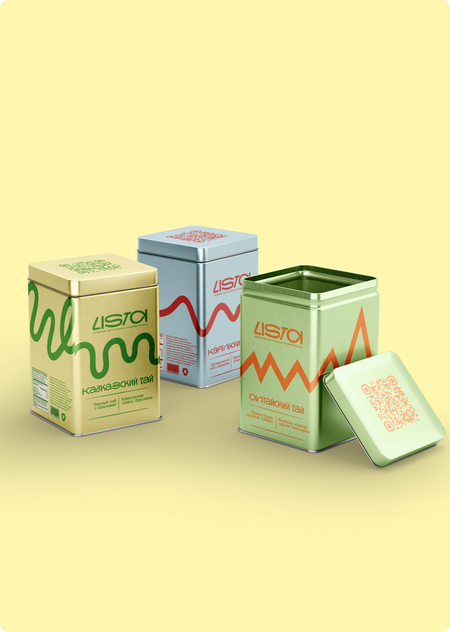
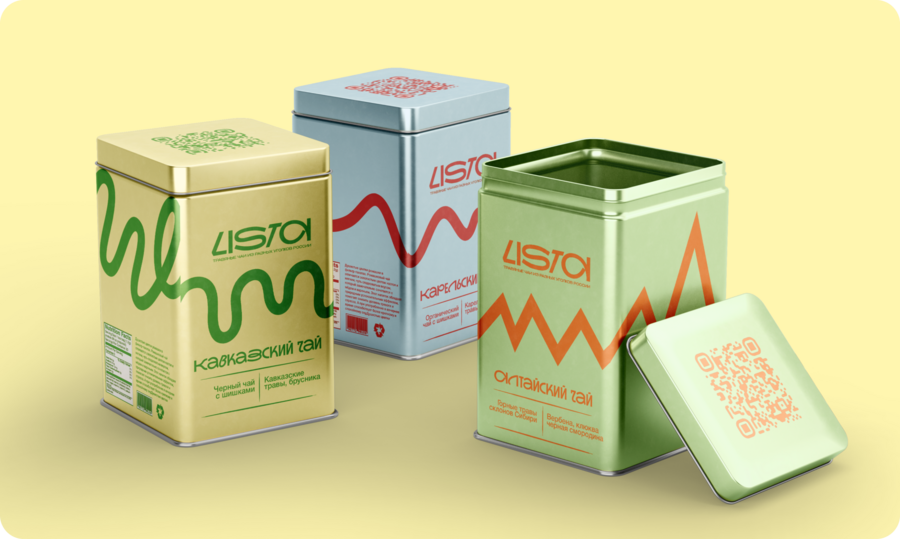
The Altai region is framed as energetic and challenging. The embossed angular line, ascending at sharp angles, resembles mountain peaks and the physical act of climbing — much like the tea’s vigorous, crystalline character. The warm orange (FE8C41) and pale green background (D5F8BE) evoke high altitude and bright alpine light, conveying urgency and openness. The line itself seems to move upward, pulling the eye toward brightness and elevation. The drone film establishes this visual metaphor through movement. The camera rises through mountain passes, revealing the sheer scale and solitude of alpine terrain, the wild tea plants growing in meadows where cultivation is nearly impossible. The tea itself reinforces this frame. The flavor is sharp, like the air at altitude. It tastes clean, demanding presence and attention. This is not an easy, comfortable tea — it is a tea that asks something of you.
Caucasus — Warmth and Movement
Caucasus is framed as warm, generous, and inviting. The embossed serpentine line flows horizontally in multiple curves, resembling a winding mountain road that moves through valleys rather than climbing them. The warm green (51A81B) and gentle yellow (FFF6AF) suggest comfort, light, and hospitality — the visual opposite of Altai’s severity. The line moves gently and playfully, inviting travel rather than demanding it. The drone film follows this serpentine path, winding through terraced plantations and sunlit valleys. The camera moves with ease and rhythm, revealing layers of landscape: the places where Russian tea cultivation began in 1901, in regions rich with subtropical sun and dark earth. The movement is measured and warm, never urgent. You feel welcomed into these landscapes, not tested by them. The tea here is the most generous Russia produces. The flavor is full, complex, deeply satisfying: it tastes like warmth and generosity. This is a tea that offers comfort and connection. It invites slowness and conversation
Karelia — Northern Clarity
Karelia is framed as severe, precise, and beautifully austere. The line smoothly superimposed on the cool blue background (C8E8F6), creating stark contrast and visual tension. The bold red (CF4648) against cold blue is uncompromising, there is no softness or middle ground. It does not flow or ascend — it simply cuts through, like a path through wilderness. The drone film navigates through dense dark forest, revealing sudden clearings, pristine lakes, and crystalline sky. The contrast between dark and light is sharp and poetic. The aesthetic is severe and beautiful simultaneously. You see the north not as hostile but as honest and beautiful in its absolute clarity — a place where things are exactly as they are. The flavor is bright and precise: it tastes like winter forest, and the clarity that comes from harsh light and open space. This is a tea that requires you to be present and honest with yourself.
The Container as Ritual Object
The metal tin is reusable. After the tea is finished, you keep the container. The embossed line remains permanent, its texture unchanged by time. Over months of use, your fingers trace the same ascending angles, the same curves, the same sharp cuts. The container becomes a tactile bookmark for a place. Over time, you may collect all three: Altai, Caucasus, Karelia. The three containers together form a small map of Russian regions on your shelf, a physical representation of exploration. LISTA promises one simple thing: Open a container. Taste a region. Become a traveler without leaving home. The tone across all three teas is warm, curious, and human-centered. The brand feels approachable and exploratory, not luxury or pretentious. Thick embossed lines and imperfect forms make the brand feel made and intentional, not mass-produced.
Where to Find LISTA
Main channels include specialty tea shops and independent design galleries, museum gift stores and cultural institutions, and direct e-commerce. The brand positions itself as a gift for travelers, friends moving to new cities, or anyone seeking meaningful objects that connect them to place. Limited edition regional sets work as gifts for specific occasions — a friend leaving Russia, a traveler planning a journey, or someone collecting the complete map.
III. LISTA for a Professional Audience
LISTA is a modular visual system that connects regional Russian geography with herbal tea typology. Each label is a variation on one consistent structure: region name, tea composition, embossed line, map anchor, and technical information. Labels follow a loose but repeatable grid: LISTA logotype at the top in bold sans serif, region name as a secondary element, embossed line as the central organizing visual, the Russia map as a subtle background element, and brewing instructions at the bottom. This ensures brand consistency across all three variants while allowing distinct regional expression.
Visual System and Line Language
The core visual constant is the hand-embossed line. Each line type functions as both regional identifier and tea character indicator: Altai line: Angular segments ascending at 45-degree angles, suggesting mountain peaks and upward movement. The line is discontinuous. It breaks and restarts — creating visual energy and tension. When embossed on metal, the breaks create shadow variation, adding tactile dimension. Caucasus line: Flowing serpentine curves that move horizontally across the container width. The line is continuous and rhythmic, suggesting road or river movement. The curves are generous and rounded, never sharp. Karelia line: Smooth geometric line creating a wave pattern. The line moves in multiple directions without following a clear path, suggesting navigation through complexity. Embossing (rather than printing) was a deliberate material choice. It makes the line permanent, tactile, and visible from multiple angles. The line becomes part of the container’s structure, not its decoration.
Color Palette and Emotional Framing
Colors are chosen to reinforce both region identity and tea character: Region Line Color Background Emotional Frame Altai Bright Orange (FE8C41) Pale Green (D5F8BE) Energy, altitude, brightness, challenge Caucasus Warm Green (51A81B) Soft Yellow (FFF6AF) Warmth, generosity, movement, ease Karelia Bold Red (CF4648) Cool Blue (C8E8F6) Intensity, clarity, precision, severity
The Russia Map as Symbolic Anchor
The outline map of Russia appears subtly on some visuals at low opacity, positioned as a background element behind the main graphic elements. The map functions symbolically, not functionally — it signals that this tea is part of a larger system of regional exploration. The map serves three professional functions: 1. Brand system cohesion: All three containers share the map, creating instant visual recognition that they belong to one brand family; 2. Symbolic extension: The map primes consumers to think in terms of collection and completeness («I should own all three»); 3. Narrative anchor: The map connects individual regional teas to a larger Russian geography story.
Digital Extension and Modularity
From a professional perspective, the system is designed for scalability. Each new region requires: • A new embossed line pattern (following the established logic: ascending/flowing/jagged) • A new color pair (maintaining contrast and emotional distinctness) • A new drone film (90-120 seconds, consistent cinematography style) • A QR code pointing to that film The core grid structure, logotype, and map remain constant. This ensures that adding Siberia, the Urals, or the Far East would strengthen brand recognition rather than dilute it.
Material and Production
Metal containers (aluminum or tinplate) are 200ml or 250ml capacity, standard tea container proportions. The embossed line runs horizontally around the container’s front face at approximately 40 mm from the top. QR code placement on the lid ensures it’s the first thing consumers encounter when opening. The embossing technique requires metal tooling, but allows for unlimited reprints of each variant without additional setup costs after the initial tool creation.
IV. How Communication Theory Shapes Professional Strategy
We focus not only on visual style but also on theoretical questions: How can a tea container be a communication medium? How do people emotionally respond to embossed lines and regional colors? Why would they choose LISTA over undifferentiated tea?
Based on Media Ecology, we treat the container as an environment that shapes the entire tea drinking experience.
The embossed line is permanent and tactile — it communicates through touch, not just sight. Unlike a printed label that wears away, the embossed line remains with every use, deepening the association between the regional identity and the tea’s character. The container is not packaging we discard; it is an object we keep and reuse.
Framing Theory helped us understand that people already have mental associations with Russian regions.
Instead of fighting these stereotypes (Altai = harsh, Caucasus = warm, Karelia = cold), we use them deliberately. The ascending line, the serpentine curve, and the sharp cut are visual simplifications that feel immediately familiar and easy to decode. The color palette reinforces these frames without requiring explanation.
The Narrative Paradigm frames each container as a story unit. The embossed line on the container primes narrative expectation.
The embossed line on the container primes narrative expectation. The drone video fulfills that expectation through authentic footage. We continue this storytelling online through social media, and we encourage our audience to share their own experiences to become part of a community built around regional exploration.
Overall, the project demonstrates how theoretical concepts become practical design decisions. Rather than using theories only as written justification, we embedded them into the physical medium, the visual system, and the communication strategy, so they are visible through the brand experience itself.
V. Bibliography and Image Sourses
This project is based on materials from the course «Communication Theory: Bridging Academia and Practice» taught at HSE School of Design, 2024–2025 (accessed: December 14, 2025).
All images presented in this work are original and created by the author. No external visual sources were used.