EthnoLab — Communication Theory
How communication theory works in the field of design
To start designing anything that is to be sold to public, whether it is something physical or imaginary like ideology, one has to be aware of the theoretical base. Communication theory works for multiple areas of life, and design is not an exception.
The definition of communication theory says: communication is a systemic process in which individuals interact with each other through symbols to create and interpret meanings. This is exactly what defines the way it is used in design. Artwork becomes more than just a decoration: it turns into a tool to deliver a specific message via working with symbols and concepts that are to be decoded by the audience according to their context.
For example Craig’s seven traditions help to build the narratives and messages exactly the way to make the audience decode them as the author wishes. Knowing how each part of this theory works helps to compose such design that would hit the spot of the potential viewer.
There are multiple approaches to the theoretical base that are helpful when working on narratives and design. Interpretive theories encourage multiple realities—users' unique combinations reflect personal values. Objective theories predict outcomes, like testable hypotheses on engagement from cultural mixing. In combination these approaches help to construct the design and message that will reach the public the right way.
EthnoLab — Presentation for a general audience
Welcome to EthnoLab — your personalized folk experience
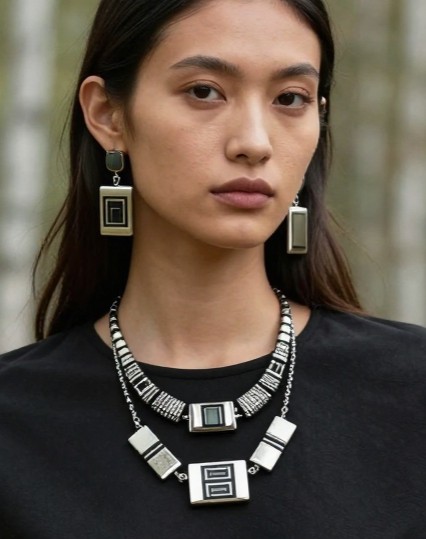
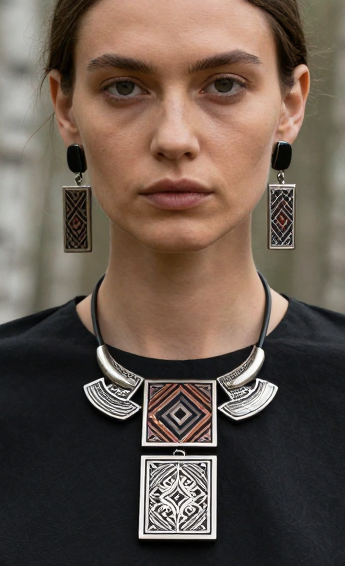
Example of EthnoLab jewelry on models, AI-generated images
You may have come across ethnic ornaments and motives both in fashion and your daily life — you probably remember that one white towel with a hand-sewn ornament your grandma had in her countryside house, don’t you?
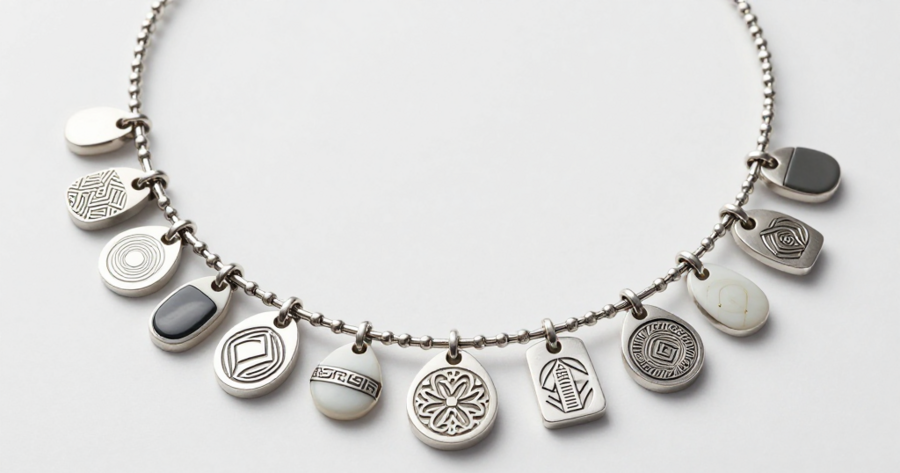
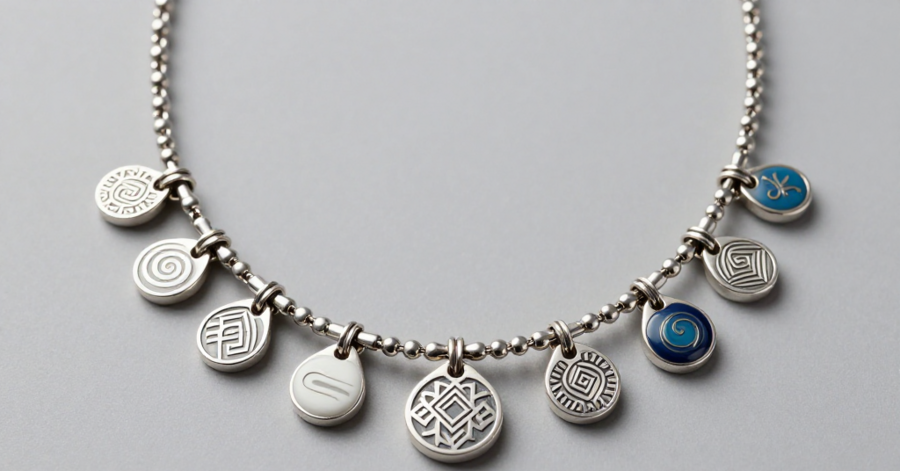
Example of EthnoLab jewelry, AI-generated images
Our country is almost the size of a continent, and more than 190 ethnicities with their own culture and art have been living next to each other for centuries now. It may seem so mysterious — distant cultures, distant meanings.
Example of EthnoLab jewelry, AI-generated images
But what if we tell you that mystery is just at your reach? Imagine having your own unique jewelry, making a mix of the vibrant patterns of Russian diverse cultures. How about blending Komi ornaments with Tatarstan floral motives?
Example of EthnoLab jewelry, AI-generated images
EthnoLab is exactly made to make this come true. We offer a modular jewelry constructor on our website — you assemble unique pieces from ethnic-inspired modules. Build your personal ethno-formula with its own meaning!
Mix and Match Cultural Stories
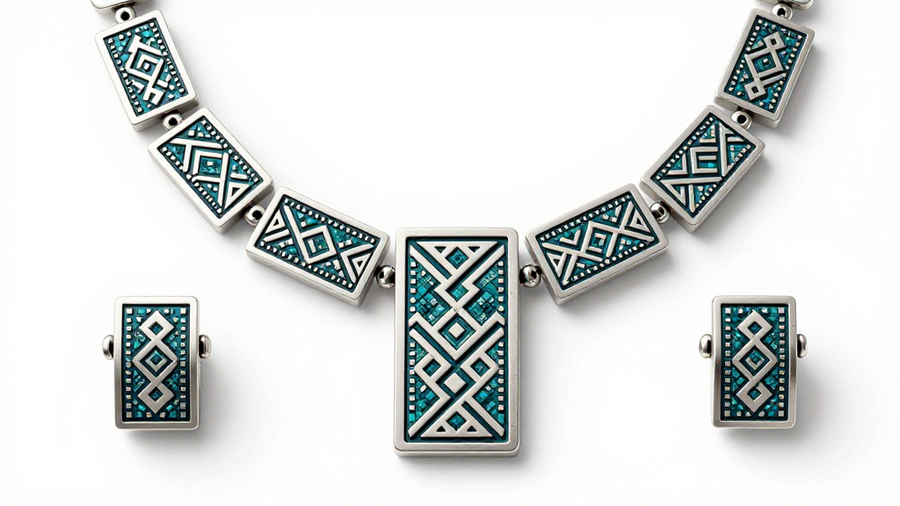
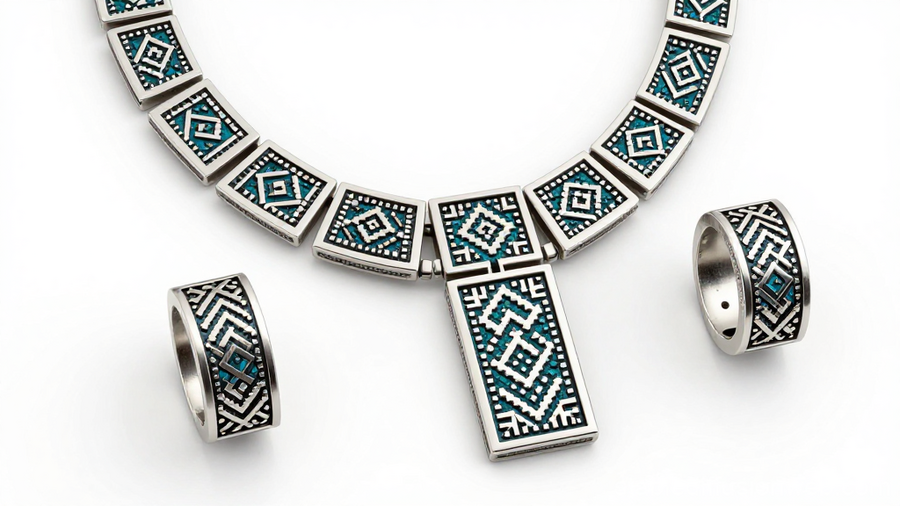
Example of EthnoLab jewelry, AI-generated images
Each module draws from real ethnic groups: Komi with its geometrical ornaments, Yakut (Sakha) with neat floral curves, Tatarstan with elegant tangles and colors. Chukotka for simplified yet enchanting shapes, born in arctic snows. Arkhangelsk with animalistic shapes.
Example of simple, non-modular EthnoLab jewelry, AI-generated images
Behind every curve and turn stands its meaning, given by the ancestors many centuries ago. Some attract love, joy or luck, some are guardians against evil spirits.
Each type of ornament you can choose in our constructor is supplied with a small cultural article: it doesn’t plainly say what this ornament means, but gives a deeper dive into the cultural context.
Why EthnoLab?
Example of EthnoLab jewelry, AI-generated images
When you wish for individuality and roots, EthnoLab lets you craft one-of-a-kind pieces that represent a multinational spirit.
It’s modular, so you can buy multiple pieces and recombine them according to your will. Its meaning is only defined by you. And the heritage it brings represents how various and wonderful our people are.
We’ve collaborated with anthropologists, with local craftsmen who inherited the art of making ornaments and jewelry from their previous generations. All for you to have a unique and life-accurate experience with our jewelry.
Join the polyphonic chorus
Example of EthnoLab jewelry, AI-generated images
Ready to experiment? Visit our websites or pop-ups in major cities. Share your creations on social media for inspiration. EthnoLab isn’t just a trinket — it’s a personal cultural symphony. Wear your own culture! Wear your story!
Presentation for other designers
Design concept of EthnoLab
EthnoLab presents a new and never-before-seen approach to customizable jewelry through the lens of cultural and hereditorial diversity. Our brand introduces the concept of combining elements of different bijouterie pieces, each representing a unique aspect of a specific ethnic group’s traditional background.
Whe applied the same logic when naming the brand: the word «EthnoLab» represents the user’s ability to create unique jewelry pieces as if they were working in a laboratory of design.
These «ethno-formulas» allow fashion-based self-expression and encourage gifting and sharing: by purchasing pieces for loved ones, users are able to create unique designs with bonds woven into them.
The brand is also a collaboration with artisans, an alliance that provides personality and signifies the jewelry’s place on the market. Each piece features stories and pictures of craftsmen, allowing consumers to build connections with the tales behind the bijouterie.
Methods and approaches to design
All pieces’ concepts are backed up by research: the bright knitting and ornate patterns of the Komi peoples represent connections to nature, the warm and fuzzy cloth bracelets referencing the traditional clothing of the Yakut people are meant to represent resilience and strength. Every module is designed in a way that allows a wide range of customization options: bracelets, rings and necklaces can be layered and fragments of jewelry pieces can be attached to each other.
Computer-aided design is used to ensure geometric accuracy and availability for customization.
Target audience and communication strategy
EthnoLab targets culturally curious millennials, emphasizing personality tied to a group that resonates with the audience and cultural representation which is a popular concept among the generation. Using narrative storytelling and personal stories of artisans as a means of marketing communication helps build connections between the consumer and the brand.
How the communcation theory served as basis for EthnoLab presentation
We started with the basics: Semiotics from Craig’s tradition. We realized that a Yakut ornament or a Komi pattern isn’t just decoration — it is a sign encoded with centuries of meaning. By letting users mix them, we are essentially letting them build a new visual language. We also applied McLuhan’s Media Ecology and his idea that «the medium is the message.» The modular structure of our product speaks about diversity and connection louder than any slogan could.
Our core mechanic comes from a clash of theories regarding identity. Psychologically, Optimal Distinctiveness Theory taught us that people crave two opposing things: to stand out and to fit in. EthnoLab solves this: you customize the necklace to feel unique (differentiation), but ties to an ethnic background show you belong to a broader culture (assimilation). Structurally, we connected this to Castells’ Network Society. Modern people don’t belong to just one rigid community — we are «switchboards» connecting different networks. Our jewelry reflects this: each charm is a «node», creating a personal network of cultural connections. This also touches on Intercultural Communication, bridging the gap between collectivism and individualism by allowing users to disclose their complex identity without saying a word.
When developing EthnoLab, we didn’t want to create just another ethno-brand. We turned to communication theory to figure out how jewelry could act as a genuine tool for connection. Here is how we linked the theory to our brand:
For our general audience, we stopped using logical arguments and embraced Fisher’s Narrative Paradigm. We realized humans are «storytelling animals». So, instead of just selling silver, we sell the story behind the ornament and the biography of the artisan. We focused on Narrative Fidelity — making sure these stories actually resonate with the user’s values of authenticity and roots.
Since we use ethnic patterns, we were terrified of exploitation. We looked at Critical Theory and the Frankfurt School to understand how not to turn culture into a soulless commodity. The lectures on Walter Benjamin warned us that mass production kills the unique «aura» of art. To fight this, we applied the Dialogic Theory. It argues that communication must be an honest exchange, not manipulation. That is why we name every artisan and tell their story to create a true dialogue between the creator and the buyer. We aim to create a public sphere where these cultures engage in a dialogue rather than being silenced by commercialization.
Finally, we used the concept of affordances. We realized that we are designing possibilities for action. The jewelry constructor on our website isn’t just a feature — it is an affordance that signals: «You are the creator here». It turns the user from a passive consumer into an active participant in the design process.
List of literature and sources of images
Please note that our brand illustrations are generated by Stable Diffusion AI — we used it to visualise our concept primarily.